Showing posts with label England. Show all posts
Tuesday, February 28, 2017
Humanity for Beginners by Faith Mudge
Humanity for Beginners
by Faith Mudge
Pages: 71
Publication Date: February 13 2017
Publisher: Less than Three Press
Series: --
Review
Rating: 5+
Read: February 28 2017
*I received this book from NetGalley, and Less than Three Press in return for an honest review.*
I believe that the most recent werewolf story/book I read I made some comment about how it had been the best, or among the best or . . . well, I've this vague recollection I made a comment like that regarding a werewolf book relatively recently. I've also relatively recently rated two werewolf books close to 3 stars, so I've not exactly gone out of my head regarding werewolf stories.
Why do I mention that? Why do I start off my review that way? Simple. I surprised myself here. I, somewhat randomly, looked at various books/short stories on offer on Netgalley, saw this story here, thought it looked interesting, and read it. And, I have to say, found myself in a warm fuzzy place that actually made me teary-eyed at a few moments (no idea what that's about, maybe my eyes are off). And, not only do I have this vague feeling that I've just read one of the better werewolf stories I've attempted, I also feel as if I've read one of the better lesbian stories. I do not wish to use the word 'best' or 'one of the best' as I seem to be miss-using that phrase/word lately. But . . . something like that.
The story? Something like a slice of life look at a group of women living and working in England. At a bed and breakfast (there was some comment that flew past me without me paying much attention indicating that it was something different than that . . . but I might have misread that). All have some 'issues' they are attempting to get through, pasts to live down. A lot of those issues occurred/developed because of another thing all these women share in common - they are werewolves.
There's Gloria, the 'not-the-alpha' who owns and runs the place, Nadine the chef, Lissa & Louisa who are loners/and or newly bitten (within six months) who are the waitresses (and have been circling each other. Then there's . . . the gardner man. Who is human. And whose name is escaping me for some reason. mmphs. Then there's Eben, another human, who comes calling one night looking for someone.
Lovely story. As mentioned, warm and fuzzy. Fun. Unexpectedly explicit briefly (I had accidentally mixed several book snippets together and forgot this one did have that bit about 'some explicit content'). It probably hit me differently than someone else, especially if they read it after reading my review. Since I wasn't expecting anything and they would be (it's one of those 'went so far and then . . . new scene' type of explicit action).
I've never read anything by this author. I now desire to dive into their work and hopefully find some more interesting stuff.
Rating: 5+
February 28 2017
Monday, July 18, 2016
Another One Goes Tonight by Peter Lovesey
Another One Goes Tonight
by Peter Lovesey
Pages: 401
Date: July 5 2016
Publisher: Soho Crime
Series: Peter Diamond (16th in series)
Review Rating: 5.5 out of 5.0
Read: July 17 to 18 2016
This is my 34th book by Lovesey, 16th in the Peter Diamond series. Actually, 35th book, I forgot that I read 1 book by Lovesey under another name. Though I forget, at the moment, the specific name. Peter Lear, I think.
Other than random short stories floating around in places I cannot reach, a couple, I think, of Lear books I do not have access to, and 2 books in one of Lovesey's series, I've read everything by this author.
I have not always loved everything I've read, and, for the most part, I'd say that he is a damned good writer. Barring a few exceptions here and there. The only book by him that I've rated as low as 2 stars is the first book in his 'Albert Edward Prince of Wales' series - which leads directly to the reason as to why I haven't read the two other books in that series. And, other than that 2 star book, this book here (which I gave 5.5 stars to), the book 'On the Edge' (3 stars), and the Lear book (another 3 star book), everything I've read by Lovesey I've given 4 stars to. Well, some rest on a 4.5 shelf and the like, and some might have been closer to being 3.8 books, but none of that matters here at Goodreads, not when we do not have half stars and the like, so 31 books rated, by Goodreads standards, 4 stars.
Doesn't really take much thinking to understand how happy I am when I happen to notice a new book appear by Lovesey.
Lovesey's something of an odd one when it comes to plot lines and characters. He has had killers as the main character, and murder suspects, and one or several that involve the point of view of an amateur doing some deducting, while one of his series regulars works on the case from another direction. Even when you think of series, there are oddities - like you do not expect a police series to start off with the main character in the police, then - for various reasons, he suddenly isn't in the police any longer and is a P.I. (or working security, I've forgotten now what jobs he had during his break), then back to being a police person.
I mention all that, the odd little things that turn up, because that occurs in this book as well. This is both not a straight forward murder mystery, while at the same time it is a book about a serial killer (that part isn't a spoiler, the serial killer part, because the reader has snippets from the killer's journal at various points of the novel).
It is not a straight forward murder mystery, because no one actually realizes that there are any murders to investigate. For, you see, Peter Diamond has been tasked by his boss to work as the local professional standards guy to investigate a motor vehicle crash. That's right; one of the top homicide detectives has been tasked to be something like a crime scene investigator for a motor vehicle accident, specifically tasked with the assignment to determine if the people in the vehicle handled themselves in a professional manner . . . or something like that. The police are looking into that because the car that crashed was a police car. And, when Diamond gets the assignment, there is one dead police officer, and one severally injured one.
So, Diamond and two of his underlings investigate. Diamond arrives at the accident scene about 45 minutes or so after getting the assignment, which was about 3 hours after the accident occurred. Which I mention because Diamond spots something no one else spotted in the 3 hours that the scene had been investigated – he finds that another vehicle had been involved in the accident and that there was an unconscious, possibly dead body up in the bushes (I have it perfectly outlined in my mind the scene, and bushes isn’t correct, let me see – the body was up a hill in some vegetation and hard to spot without being up the hill).
I mention all that because the book focuses directly on the person who was found, and the possible activities that individual might have been involved in. Activities, based on various objects and papers found, that might involve murder – murder of various people whose deaths had been declared natural or accidental (mostly natural – old people dying in their sleep). But were they actually natural deaths, or is there a serial killer on the loose?
A quite interesting book. Quite enjoyable read.
July 20 2016
Tuesday, June 14, 2016
The Fifth Gospel by Michelle Grubb
The Fifth Gospel
by Michelle Grubb
Pages: 240
Date: January 18 2016
Publisher: Bold Strokes Books
Series: None
Review
Rating: 5.0 out of 5.0
Read: June 13 2016
I read Girls with Guns back in March. That is a short story collection that had, at that time, included three authors I had never previously read. Though I had had at least one of them on and off the possibilities list for years. I gave the Carsen Taite story in that book a rating of 4.85; the story by Grubb a rating of 4.75; and the story by Ali Vali a rating of 3.00. I mention all of that to then note that I proceeded to read 5 books by Taite, and 1 by Vali before, at long last, I tried a full length work by Grubb.
Which brings us to this book here. Two things to note immediately: I rather liked Flic Bastone from the beginning and that impression never changed; I didn’t particularly like Anna Lawrence when I first meet her, but she, eventually, grew on me (I made a comment at some point that I wished I wasn’t inside Anna’s head; because her thoughts her not helping me like her much up to a certain point). I mention that because there are several elements that might otherwise have caused me to lowly rate this book. The book was, at least in my opinion, saved by the romance between the two. Not to imply that the plotline and other ‘non-romance’ parts were bad or anything. But the romance really helped push the book along and helped me rather like the book.
I had certain problems along the way:
1) I have certain difficulties about books like this – the kind that seems to include mention within it of the idea that some ‘big thing’ is going to ‘destroy the church’. Reminds me of a short story I read. It was alternate history. Involved Lewis and Clark heading out on their expedition and seeing . . . . a wooly mammoth. Therefore utterly destroying the church. Wasn’t a badly written short story, but the logic escaped me. I think it had something to do with evolution, or the possibility that wooly mammoths were not explicitly mentioned as being among the animals on Noah’s ark or something else equally grand. Admittedly having the Pope turn out to be both gay and in a gay relationship would have an immense impact on the church. I just don’t see that that in of itself would ‘utterly destroy the church’. Hell, you have priests, bishops, and the like raping young children and the church slumps along un-destroyed – and that’s with the church mostly attempting to a) cover it up; b) moving priests around instead of cutting their balls off (they are the church, I assume they could do that if they wanted), or defrocking the priests. Actually, I've wondered why they, way back when, hadn't gone with a eunuch priesthood (the Catholic Church at least). And, I should note, eunuch's are not exactly unknown to the church - there was a time they made certain types of singers that way, by cutting off the balls of little boys.
2) saying all that in the first part, my bigger problem was Anna and her connection to the church. It, in various ways, confused me. She herself said she had a relatively . . . um, well, I forget now what she said, but she is not from an ultra religious family, I’m not even sure her parents are even religious at all. No, she’s just someone who was the offspring of people who moved a lot and had had Anna by accident; and a person who found ‘contentment’ in seeing a church at each location they moved, and spending time in it (I suppose I should be glad that it hadn’t been a McDonald’s she latched on to, eh?) Anna’s personality and character would have made a lot more sense if her back-story had been different. Hell, I had a stronger connection to the Catholic Church growing up than she did, based on what is revealed in the book, and I didn’t reach adulthood assuming that every single bloody Catholic is exactly the same (the numerous times she spoke for the billions of Catholics was very annoying. Stop speaking for me, bitch).
Right. So. The book was enjoyable. The relationship between Anna and Flic was good enough to pull me along. I had certain issues with Anna specifically, though not with the depiction of the church or its supporters/opponents. More with Anna’s connection to the church.
I wasn’t sure if I’d actually get around to reading a book by Grubb, despite loving that short story I had read, since none of her books looked like things I wanted to read. The most interesting one had that church/religion connection, and I’m less than interested in reading that. But I’m glad I, forced might be pushing things, myself to read this book.
June 14 2016
Wednesday, May 4, 2016
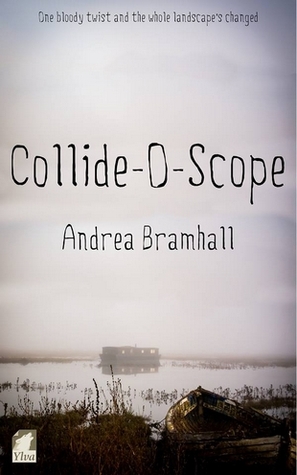
Collide-O-Scope by Andrea Bramhall
Collide-O-Scope
by Andrea Bramhall
Pages: 390
Date: April 10 2016
Publisher: Ylva Publishing
Series: Norfolk Coast Investigation Story (1st in series)
Review
Rating: 4.70 out of 5.0
Read: May 3 to 4 2016
I received an ARC of this book from NetGalley and Ylva Publishing in exchange for an honest review.
This is my second book by this author. I rather enjoyed the first book I had read by this author.
Location
A small village, Brandale Staite, in North Norfolk England. A place of 39 year round residents (there had been 40, but Connie’s dead now). The village swells to four hundred ‘in season’. ‘The campsite holds six hundred people per night.’
Note: there is a map at the front of the book. It shows King’s Lynn (where Kate lives and where a second murder investigation takes place off-scene), Hunstanton (where the police work out of while investigating) but does not show Brandale Staite (unless that is also called Brancaster?).
Main Characters
There are two points of views in this book.
Detective Sergeant Kate Brannon is relatively newly promoted to her position (three weeks before the beginning of this book), and relatively newly arrived in the area (moved to Kings Lynn from Norwich at same time as promotion). Though she grew up in a small village like setting near the sea. Nearish to an oil rig. This is important since her pop worked on one. Before it burned – it and him on it. Mother died when Kate was young. So she was raised by her grandmother, but she’s passed on now as well (when Kate was 17). Kate is currently 35. Drives a BMW Mini.
Of Importance: There is a question that Gina asks Kate, something like ‘will someone miss you when you die?’ the answer is ‘no’.
Georgina ‘Gina’ Temple is a woman who works as the second in command at Wells campsite (the manager). She is a mother of 9 year old Sammy, who she had when she was 17, making her 26 when the book opens. Had liked drinking a bottle of Shiraz with Connie. Also drinks Rioja.
Of Importance: Sammy (daughter), Matt Green (father of her child), and Connie Wells (boss and friend).
Secondary Characters
NOTE: Since this is a mystery and ‘everyone’s a suspect’ I’ve attempted to add people as their names came up the first time. Not by order of importance.
Police
Inspector Savage is the person in control of the crime scene where Wells body was found. He is meet at the beginning of the book, and mentioned several times thereafter but has little to no interaction with the story after the beginning.
Detective Inspector Timmons is Kate’s direct boss and would have normally lead the investigation of Wells death but for a slightly higher priority murder investigation involving three women in a ‘the middle of King’s Lynn.‘
Dr. Ruth Anderson is the medical examiner.
Sergeant Stella Goodwin is ‘an experienced sergeant’ who will handle the inside the office stuff, while Kate handles the outside the office investigation. Technically she has been 'left in charge' when Timmons goes off to attempt to solve some other 'more important' case. I say technically because Goodwin and Brannon more often work together than have Goodwin dictate what Brannon will do.
Detective Constable Jimmy Powers is Kate’s assistant. ‘A guy in his late twenties.’
Police Constable Collier is a newbie partnered up DC Brothers. Both working on the investigation.
Detective Constable Tom Brothers works on the investigation. Makes jokes a lot. He ‘looked a little like a panda in reverse.’
Len Wild is the head of the forensics team working on the murder investigation.
Villagers
William Clapp is a worker at Wells’ campsite. He is a ‘thin, blonde guy’ with a ‘diamond earring . . . in his left ear.’
Leah Shaw is Connie’s ex. Described as being the people person of the relationship, though that is not in evidence in the book. Leah is currently bunking with Ally Robbins.
Matthew ‘Matt’ Green is the father of Sammy Temple, and works for Sands. Lives in ‘Pebbles Cottage, Brandale Staithe.’
Ally ‘the Cat’ Robbins works on a lobster boat (or a fishing boat at least). Has a reputation of being ‘a tramp who’ll sleep with anything that doesn’t say no.’
Edward and Rupert Sands are the people that own half the village. Something like bitter rivals of Connie Wells.
Murder Victim
Connie Wells is/was a woman who ran the successful camp site in the village – the one that, in season, provides a great deal of support to the rest of the business in the village. The campsite is called ‘Brandale Backpackers and Camping.’ She was formerly attached to a woman named Leah, but sometime in the past, prior to the start of the book, they had split apart (six months prior?). Everyone, including the ex, but not including Gina and Sammy, describes Connie as being a bitch. And kind of disliked her. Medical examiner gave an approximate age for Wells of between 30 and 40.
Of Importance: Merlin (dog), Leah (ex.), workers of her business, villagers
Plot
The book opens with a prologue. One that I see occasionally and kind of dislike for one specific reason. It allows the reader to see the character alive and bouncing around as a fully realized character. Then kills them. There’s a reason I stopped reading so many mysteries. Gets depressing – that.
Well, so, the book opens, and a woman is out walking her dog along a particular path near a marshy flood plain. She has her camera with her and is taking pictures. Unlike most of her times taking pictures, she is less focused on nature and the like, and more on what is happening involving some lobster traps.
Gun shots go off. Merlin, Connie’s dog, squeals in terror. The birds flee. Connie shrugs. The noise makers have gone off – sounds that are made in the morning by farmers to drive off birds.
Connie raises her camera and focuses. Another shot goes off.
Chapter one finds a Detective Sergeant Kate Brannon heading to a crime scene. There’s a frantic dog being held by a police officer, a crime scene inspector, and police. The police do not yet know who the victim is, since she does not have any identification on her, and she is missing her face.
The book proceeds with following Brannon as she investigates. Timmons, her boss, would normally be the lead investigator, but another case comes up of slightly more importance.
Relatively quickly, like in the first chapter (I think I recall), the identity is revealed to the police, though, of course, the reader already knew. Connie Wells has died. By gunshot.
Wells, it turns out, has a business in the village, or on the outskirts, that involves a seasonal campsite. That campsite adds a ton of business to the village, and, as some note, the village itself would greatly suffer if that campsite were to close. Which, as it turns out, Wells was within a week of doing. And the whole village knew about this issue.
Meanwhile, Wells has an ex-girlfriend who has made threats against her.
The richest family, or at least the one that owns half the village (I rephrase as I do not know how wealthy Connie might have been), also despise Wells. It was mutal.
So – everyone wanted her dead. Well . . . not exactly. One at least wanted her dead. The rest? Baring a few here and there (including Gina and Sammy Temple, and possible one or more of her other employees), just thought she was a bitch.
So Brannon must first determine who the victim was, then who killed her.
Overall
There are many types of police books – a few of the varieties include (1) those that are mostly about the crimes and the people who investigate them (emphasis on investigation – police procedural – ‘just the facts’); (2) those that are like 1, but include a heavier emphasis on characters; (3) similar to 2 but injects romance while still focused mainly on the investigation; (4) like 3 but focus is mainly on the romance, while the investigation takes something of a back seat; (5) those which are mostly romance in nature, maybe mixed with danger, but the focus is heavily focused on the romance; plus a million and one other variations.
This book is one that leans between 2 and 3 above – the book is heavily into the murder investigation (Kate), with some character development stuff (Gina), while having a bit of romance floating in the air . . . lightly in some places (beginning), a lot heavier in others (80%+) (Kate, Gina).
I was thinking, while reading this book, that it reminds me of reading a Peter Lovesey book. I did not have a fully developed thought when I was thinking of Lovesey – beyond the idea that, unlike many/most lesbian fiction mysteries that involve the police, this specific book had a Lovesey vibe. This means nothing to those who have no idea what I’m talking about, of course. See, not fully developed thought. My point of thinking of him, had to do with emphasis – a lot of the lesbian fiction mysteries I’ve read have had romance be something of much greater importance than the mystery (at least those that include the police – there are many wherein it seems as if the characters in the story forget that there’s actually a mystery to solve, in favor of . . . um . . humping); while this book here gives greater importance to the mystery.
Still, no inherent reason to bring Lovesey up. It was just a thought that had crossed my mind at some point. Lovesey’s books, specifically those that involve Peter Diamond, are ones that involve murder investigations set in England which is a more leaning 2 (depending on book and scene) with occasional dips into injecting romance. As in there is a lot of importance on characters.
Right. No idea why I had that thought. Let’s move on.
This book was a rather thrilling exciting mystery that included the right mix of romance. Granted, those who look for romance, as in capital R Romance, should probably look elsewhere, but there is a flavor of it here.
There is one slight issue I have with the book. Though it is hard to indicate my 'issue' when it occurs so late in the book that I can't really mention it. I'll just say that there is something of a cliche in lesbian mystery books that pops up near the end. Though, to be fair, I've seen the scenario play out similarly in 'mainstream' fiction. I've just seen it more often in lesbian mystery books for whatever reason. Also, to be fair, this "cliche' is handled quite well in this book.
Despite my 'issue', this a rather good book. Quite enjoyable. I would probably give the book a relatively solid rating of 4.70.
May 4 2016
Sunday, February 14, 2016
Give Me A Reason by Lyn Gardner
Pages: 662
Date: October 25 2013
Publisher: Self
Series: N/A
Awards:
**Winner of the 2015 National Indie Excellence Awards in LGBT Fiction**
**Finalist in the 2015 International Book Awards for Fiction: Gay & Lesbian**
**Winner of the Silver Medal in the 2014 Global Ebook Awards in Gay / Lesbian / LGBT Fiction**
**Winner of the Silver Medal in the 2014 eLit Book Awards – Illuminating Digital Publishing Excellence in Gay / Lesbian Fiction**
Review
Rating: 5.50 out of 5.50
Read: February 12 to 14 2016
By the time I got to this book, there were a large-ish number of reviews, and all but 24 people 'liked' the book (or 4% of the readers; I'm going with how GoodReads takes everyone that rates a book 3,4,5 and calls them 'like' for % purposes). And so, I'll just tackle a few things here and there.
1) I loved how fully formed the characters were. I'm sure there were things here or there that could be pointed at, probably some of the side characters, but there's even more fully formed side characters going on in this book than is normal in a romance.
2) And we come to the main thing I wanted to mention - the . . .genre of romance novels, I guess I could label the 'thing'. Romance novels, with exceptions, seem to be relatively repetitive in at least one way - they might not all get there the same way, they might have a million and one variations, but they tend to follow a certain path. Two people (occasionally more, but I do not tend to read love triangle books, and rarely poly books) circle each other for most of the book, and even if they 'come together' as a couple fairly early on in the book, that doesn't remove the book from the repetitive cycle. It just means that the couple will probably either have outside forces pound on the relationship (a danger/damsel in distress type situation), or internal forces pound on the relationship (fear, miscommunication, cheating, etc.). And then, as long as the book is actually in the capital R Romance category, then the book ends with a HEA (Happily Ever After) or HFN (hmm, I have the second one wrong, but whatever the letters are, they mean 'Happy for now'). Some include a chapter or two in an epilogue section that follows the couple as a couple. As a fully formed entity. Some don't have that epilogue.
Romance novels tend to get around this relatively repetitive trap of having the majority of the book being about the formation of a couple-hood instead of being about a couple as a combined entity through two to three means - (A) create a series wherein the couple in book 1 can show up as a fully formed entity in book 2 but are not the main characters (see such series like Soho Loft, that Shifter Universe by Jae, the two series by Lynn Galli (Virginia Clan and Aspen Friends) etc.), (B) have a book that's really really long, like, say, this book here. (C) is something like a trick - have romance elements but put the book in a different genre - which the fanfiction by Fletcher DeLancey involving Star Trek Voyager mostly is - Science Fiction with very strong elements of Romance. Or be like two of Galli's books - follow the same couple, but add an element, the second book changes the normal emotional 'things' that wrap themselves around a couple and slam against them, and wrap themselves, instead, around family - so it's a two book series involving a Romance, and something else (Slice of Life?).
I thought, while reading, that the book could have had a great closing roughly around the 56% mark. And when I feared, as I occasionally fear, how this specific author was going to 'mess with' the couple, I kind of wanted it to end there. I'm really really glad that the book did not, in fact, end there, though. But if it had, then it would have been two things - longer than the average romance novel (being, as it is, that 56% of the book would be 371 pages, and most Romance books from 'official channels' in the lesbian genre tend to be closer to 240 to 300 something); and, the second thing, roughly in line with that repetitive thing I mentioned above that Romance books fall into. However they get there, the books are about the formation of a couple, not about a couple living their life after formation of their relationship. Well, this 'formation' didn't end at 56%, but there was enough there for it to close, then have some epilogue tacked on the end. Then spin the second book out as a sequel. I'm, roughly, 100% happy that that isn't the direction this author went.
As I think I mentioned somewhere along the way - this is a fully formed book. A mixture of a Slice of Life book, with a Romance, with a Family novel all rolled into one (with the addition of a 'Holiday' novel slipped inside as well). It even had the element of danger/damsel in distress/etc. mixed in. And no I'm not only talking about flashbacks for that/this point.
Hmms. I just realized that I finished this book in the early morning hours of the 14th. It's one of those books I figured I'd read a little then close it for sleep, glanced at the clock and saw it was 1 am, glanced again when I realized I'd finished the book and noticed it was 3:30 am. *shrug* Back to the 14th - it's a rather good book to read/finish up on/begin the day with on Valentine's Day.
ETA: Oh, right, forgot two elements that I reminded myself of when I glanced at my status updates. This book includes a love scene, and yes I call it love instead of sex, that is arguably the best I've read. And I forgot when I was mentioning things that this book contains - it also contains humor. Bits and pieces here and there.
From my status updates:
- Now that, friends and whatevers, is how you write a love scene. A+ and words like that.
- 'Smiling at her accomplishment, Toni looked over at Laura. “I recommend we don’t open this until Scotland or the bloody thing will projectile vomit all over the motorway.”' - re: filling trunk with luggage. Was funny. I laughed.
February 14 2016
Labels:
5.0 Book,
5.5 Book,
Award Winner,
Christmas,
Contemporary Romance,
England,
Family,
FF,
Lesbian Fiction,
Lesbian Romance,
LGBT,
Lyn Gardner,
MF,
Prisons,
PTSD,
Romance,
School,
Scotland,
Slice of Life
Friday, January 29, 2016
Fragile Wings by Rebecca S. Buck
Fragile Wings
by Rebecca S. Buck
Pages: 304
Date: January 18 2016
Publisher: Bold Strokes Books
Series: N/A
Review
Rating: 5.0 out of 5.0
Read: January 28 to January 29 2016
*I received this book from NetGalley in return for a fair review.*
I think Evelyn, the main character in this book, would be about 115 if she was still alive today (17 in 1918, 26 in 1927). Just a random passing thought I had while the book was winding down.
This is the first book that I’ve read by this author. And the second book that involved lesbians living and doing stuff in the 1920s (this one specifically 1927). Though the other book I had read with that setting and theme was set in the USA. Both involved however distantly one or the other might be from the action, both have some vague connection to celebrities and theater people.
Shakespeare wrote three types of plays, Tragedies, Comedies, and Histories. The tragedies had moments of comic relief, and the comedies had bits of tragedy mixed in as well. While the histories, well, I don’t know what to say about them – they were the plays based on real life people – kings and Julius Caesar and the like.
I note this so that I can then say: the first lesbian book I read involving lesbians in the 1920s was a Comedy. This book here is Drama. Hmms. Oops. I mean, Romeo and Juliet was a Tragedy. Macbeth was a Tragedy. You know what happened at the end of them? Lots of death. Well, death really didn’t play a part in that other 1920s book, and while it played a part in this book, it occurred prior to this books beginning. This is the aftermath of a tragedy. What happens after lots and lots of people die. Hence my calling this a drama instead of a tragedy. Because the tragedy already happened, and now people are trying to live after that fact.
Hmms. Now that I look, this book is set in 1927, later than I had thought, while that other book? Set in 1931. Right so . . . not the 1920s. mmphs. That other book being The Seduction of Moxie
Characters
The book contains two points of views, though Evelyn’s POV appears to be much larger than Jos’s. Might even be something like 80/20. 80% Evelyn, I mean.
Evelyn Hopkins is a young woman from the countryside of England, the southwest peninsula, specifically Devon. Well, more specifically I believe the name given was something like West Combe in Devon, though, looking at a map, I don’t see said place. Though I do see a Woolacombe, and an Llfracombe, and a Salcombe in Devon. Oh look, there’s a Widecombe as well. And a Sutcombe, which is, oddly, in the north of Devon. And a Combe Martin. Whatever Combe is, there sure are a hell of a lot of them.
Right, sorry, I should probably just look it up (West Coombe; so I was both right and wrong. Odd how all the Combe’s on the map are listed as Combe not Coombe; well it’s West Coombe, at least, at the 89% mark). I’m doing something that I sometimes do – putting thoughts down when I’m about 90, 95% of the way to being completed. Not sure why. Ooh, there’s a Wiveliscombe also. Dang it, I need to close this map. Hehe.
Okay – Evelyn is a young woman from the southeast part of England. I think, and I could very well be wrong with this, but I think that she’s about 26. She’s not ‘modern day’ 26, though. No, she’s a product of her generation and place. Pulled from school at 14 to help her parents in their shop, while her brother gets to remain at school. Whimpering as her brother heads off to war, making a promise to ‘fly’, to, if her brother dies, to go to London. And if he doesn’t, they’ll go together. So that they can fly high. To a certain extent, the worst case scenario occurs – something of a holding pattern. Worse case in being freed to ‘fly’ or make true on the promise, at least. Brother Edward is pronounced MIA by the gov't (assumed dead because so many who are MIA end up being DIA). Months (is it only months?) later news arrivals that a fella who is badly damaged, didn’t have any identification, and couldn’t talk finally was able to convey who he was. He was Edward. So, shell-shocked badly damaged Edward returns home. Limping. Battered, bruised, barely able to occasionally utter a few whispers that might be words.
Years pass. Eventually Eddie thrusts a letter into Evie’s hands. And, through his limited means, and her ability to interpret him, learns that Edward wants Evelyn to head to London to deliver the letter. It’s a letter from Edward’s friend from the war – who had entrusted it to Edward’s hands. It’s been something like 5 years later, so it’s vaguely awkward. With certain coaxing, Evelyn is off to London, by herself, on a train.
I’d normally leave all that for a plot section, but I included it here to try to convey something of where Evelyn is coming from. Her innocence, determination, something of a ‘women’s place is this’ (in the home, not in school, etc), combined with something of a strong backbone.
Evelyn arrives in London and finds . . . two people who are important to the story, but not romantically.
Lillian Grainger and James Grainger are the brother and sister of Frank, the fella whose letter Evelyn carries to London. Once the letter is delivered, they invite her to stay in London with them. Lillian and James live in an expensive house in an expensive part of London, Mayfair. And Evelyn knows that, in any other circumstances, her place would be more with Grace – the servant in the house. Lillian is very vain, and in another era I’d call her an attention whore. In the 1920s I’ll just call her . . . vain. She cares more about clothing, fashion, being modern, being free, while at the same time ‘looking right’. She’s also a singer in a jazz club – to add to her comfortable place in society (and her vast wealth). James is less enamored with the social side of ‘modern’ times, but deeply enamored with the business side – he’s an architect and just loves building ‘modern’ stuff. He’s mostly off at work, though, so his part in the story is less than it might be. Though he seems to have developed quite a crush on Evelyn, though. Both Lillian and James look down on those abnormal ‘inverts’ (James word for lesbians). James seeming to be slightly more aggressive in his disdain about ‘them’.
Friends & or lovers: Dorothy is friends with Lillian, and to a certain extent with James. Vernon, Jos’s brother, is friends and lovers with Lillian, and disliked by James.
Enemies: Neither like Jos. James doesn’t like Jos’ brother Vernon.
Joselyn ‘Jos’ Singleton is the other person in this book who has their point of view expressed. Though only about 20% of the book is from Jos’s point of view. If I was doing this as some movies list credits, as in ‘in order of appearance’, technically I should have started with Jos. Because the book opens with a 1916 prologue involving Jos hiding under a table while bombs drop during WWI. Book occurs years later in the ‘20s, though. Jos works in the theatre, mostly as a ‘background’ type – building sets, moving things around, and the like. Oh, and she’s openly (as openly as she can be) a lesbian. Jos is something of a player, someone who doesn’t want nor need commitment. Mostly because of her back story and how she fears to trust and love someone because she expects failure and heartbreak.
Friends & or Lovers: several lesbians are friends of Jos, including Clara and Courtney (a couple), and others. Also friends with Jos is, strangely enough, Dorothy.
Something like Enemies: Lillian.
Plot
The book follows a young woman from somewhat rural and relatively poor and backwards England to London in the 1920s, after the first world war. The war that killed many of their generation. They live to forget, to remember, to live as if every moment counts, as if no moment counts and it can all be taken away in a blast. Not all fought in the war, but almost all are somewhat ‘shell-shocked’ from the traumatic experience. At least in London.
The young woman, Evelyn, arrives in London and presents a letter from a dead brother to that brother’s siblings – Lillian and James. They offer to allow Evelyn to stay and see the sights in London. Lillian shows Evelyn around to several locations, like Buckingham Palace, and to a jazz club wherein Lillian sings (and wherein Evelyn sees Jos for the first time, and, for that matter, lesbians).
The story unfolds with Evelyn, as much as she can what with her feeling somewhat trapped and under obligations in James & Lillian’s house, exploring the city of London. And, eventually, her feelings for another woman, specifically Jos.
Romance
By the very nature of this book – the times people live in, the openness/closedness of society, and other considerations, and specifically the nature of the lead character – a poor-ish young woman who basically ran away from home (at 26) to see London – the romance is at a slow pace. On one level. And at an accelerated pace in another. Also because of the nature of the time and people involved.
At a slow pace because Evelyn can’t see Jos as often as she might wish to do so. Especially after she sees Jos for the first time, and they have a brief conversation. She’s obligated, apparently, to wait on Lillian and her inviting Evie to the jazz club. So, days, weeks, time passes while feelings are examined, as needs develop.
The accelerated pace involves the action that occurs once people can actually be near each other – though, I suppose, Jos and Evelyn could have ‘done’ each other in the bathroom at the nightclub. No, by accelerated pace, I mean . . . well, I’ve been attempting to say what I mean, but I guess I can’t. Potentially. Hell, I don’t know. What is and what isn’t a spoiler mystifies me.
Overall
The opening of the book, the stuff after the prologue, was written in a way that I probably wouldn’t have continued if not for the fact I had kind of already committed to reading this book. It was overly wordy, overly melodramatic. It was . . . well, what I just said.
I don’t know if things changed, or if I had just fallen into a trance and dove in. Because somewhere along the line, I just moved past all that wordiness, that melodramatic way of talking, and just lived the book.
And this book surprised me. It was a lot deeper than I expected. Emotions were touched. Thoughts were had. Though I first noticed this not in the romance part, but in world part. In the people, times, the ‘generation that had to live after so many died’ part. Though I rather liked both Jos and Evelyn. And I wasn’t sure I would like Evelyn in the beginning, but I did, I really did.
Overall I’d give this book 5.0 out of 5 stars.
January 29 2016
Friday, January 15, 2016
Shiver His Timbers by Alex Westmore
Shiver His Timbers
by Alex Westmore
Pages: 267
Date: January 11 2016
Publisher: Broad Winged Books
Series: The Plundered Chronicles (2nd in series)
Review
Rating: 3.76 out of 5.0
Read: January 14 to January 15 2016
This second book by Westmore that I have read is closer to a 3.75 to 3.8 book than a 4 star book.
I was excited to read this book. I had finished the first book in the series shortly before the second was going to be released. But there was enough time in between finishing that book, and starting this one to allow me to develop quite a heavy dose of need/desire/want . . . to read this specific book here. So, the book got released, I got it, and promptly . . . read a different book. Well, I was in the middle of a series, so . . .. By the time I actually got back to this one, the book had a rather odd rating on GoodReads. Sure it was based on only a few readers/raters but still. Alarming. No matter, I wasn't going to allow that to influence me. (ETA: I'll note now, since the rating has skyrocketed since I saw it initially, that I had initially seen the rating at 2.50 stars. Which seems impossible, considering that no one has actually rated the book as low as 2 stars. Or 1. Or 3 for that matter).
So, I dove into the book and . . . was kind of bored. There is a kind of an inherent need in series books to have 'stuff' repeated. So that readers who had read the first book long ago, could be brought up to speed, and those who never read any other book in the series might have a chance of understanding what was going on. Which just means that I, who had just finished the first book, was bored.
There were some rather exciting moments in this book. Thrilling moments. But by no means is this book as good as the first in the series. Unfortunately. Oddly enough, or maybe fitting, things didn't really turn interesting until new characters appeared. Namely Evan and the people whose name I can't remember. Gagagaallagasheasgash or something like that. Unfortunately, Evan and the Galloglaighs didn't turn up that quickly in the book.
Unfortunately appears to be my favorite word for this review, I use it once again - unfortunately my brain is leaking from my skull, so I must flee without doing as much with this review as I might have wished to do.
Grace O'Malley and crew wander over to Scotland to try to help a pregnant Mary keep the throne of Scotland from the treacherous Queen Elizabeth of England. Meanwhile, Quinn continues her ways with the women, still stringing along both Becca and Fiona. Though Fiona is the one who supposedly has Quinn's heart. They can't be together, though, because that just isn't done. Also, Fiona is married to an English dude. At roughly the same time Mary is pregnant, Fiona is pregnant. With her second child. First one didn't make it. Fiona and all involved are concerned.
The pregnancies are relatively quickly handled one way or another and Grace and crew are back in Ireland. To pick up some Galloglaighs, 'foriegn warriors', and to take them back to Scotland to help defend the Queen. Grace splits her forces onto three ships. Her own, and two . . . um, galley? Galleons? I forget which. Quinn gets the captain seat for one, Innis gets the other. They load up their ships with the Galloglaighs, and in the process Quinn meets Evan. One thing leads to another, and Quinn is questioning whether or not she actually has developed feelings for a dude.
Clan battles in Ireland, with the help of English interference, a certain unstable in-fighting is occurring in Scotland between the Queen of Scotland and her English husband (shesh, all these people are marrying Englishmen). Death, destruction, plundering, sex, risk, danger, war sweep across this kind of short book.
Was interesting.
January 15 2016
Monday, June 29, 2015
The Princes Affair by Nell Stark
The Princes Affair
by Nell Stark
Pages: 264
Date: March 19 2013
Publisher: Bold Strokes Books
Series: A Princess Affair (first book)
Review
Rating: 4.0 out of 5.0
Read: June 29 2015
This was a difficult book in several ways (I'll just briefly note: closeted people hiding from the public; certain amount of miscommunication issues; etc.), and for the longest time I figured I'd be lucky to rate this as much as three stars. Though I never doubted I'd complete the book. In the end, though, I was able to like it enough to give it four stars.
I'm not sure if I can get myself to read another like it, though. For a long while I've been tired of the "straight woman who suddenly realizes they are actually a lesbian" theme. That's not in this book, though the Princess isn't "out". And that's the theme I'm rapidly growing tired of, the "not out" part. In this day and age, the cowering in the closet is something I'm rapidly losing patience with. At least among adult characters who are not over a certain age.
There's always a reason, of course. Mostly tied to work. Mostly I see it in acting related books (which is, in itself, funny in its way, as the perception has been long presented that the public thinks they are all wild weirdos anyway). Well, this time the reason is "royal highness", i.e., position in society.
Okay, I've read that now. I'll not "punish" this book for having the closeted theme, since I hadn't specifically read this exact storyline before (though I've run across princesses with fake images falling for a specific woman, and how that created complications, etc. etc. - though there it was a fantasy - it had to be, what with lesbianism being so open, allowed, and not questioned, heck the fake image was of the princess sleeping around, a lot, with women). I lost track of this paragraph. So I'll just conclude it with: I've read this story line now, I won't detract points based on it, but I'll try to steer clear of the theme in the future.
(I just noticed - the book wandered over Ireland, Scotland, and England; what, a day trip to Wales was too much to ask for? hehe).
Subscribe to:
Posts (Atom)